
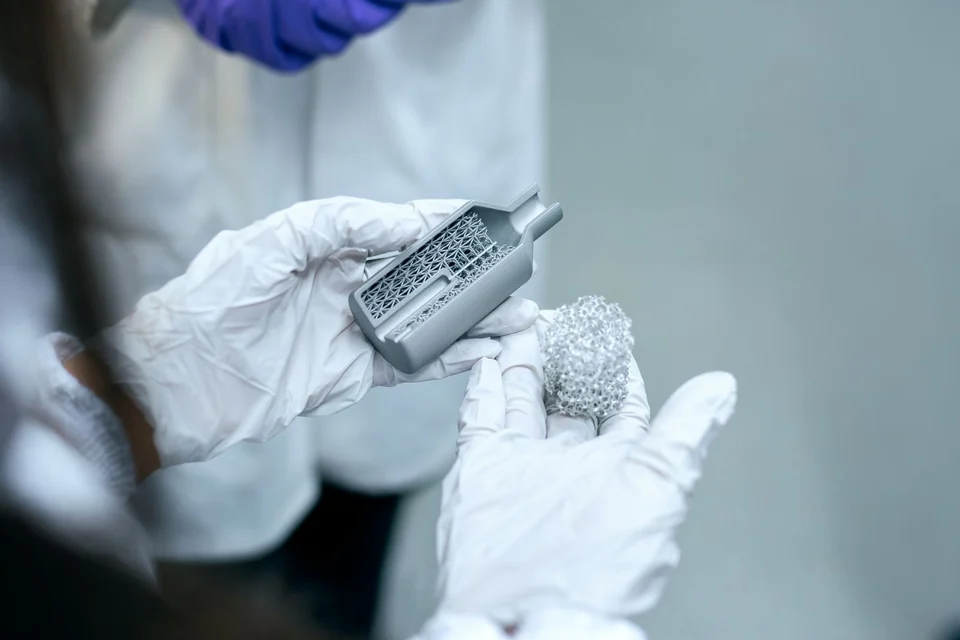
AI found a promising battery material. That is a beginning, not a finished battery. The important story is what happened after a computer selected candidates: could researchers make the material, measure its properties and show that it works in a useful device?
A collaboration between Microsoft and the US Pacific Northwest National Laboratory, or PNNL, offers a concrete example. The team used AI and high-performance computing to narrow a very large search for solid-state electrolyte candidates, then moved a candidate into laboratory work. PNNL describes the path from simulation to synthesis. The result illustrates an accelerated search, not a battery you can buy.
First, the computer reduces the search
Battery materials must meet several conditions at once. An electrolyte needs to move charge, remain stable under relevant conditions and work with the other parts of the cell. A candidate that looks attractive on one calculated property can fail on another. Searching combinations one by one in a lab would be expensive and slow.
In the research team's published account of its workflow, computational screening helped identify a smaller set of promising solid-state electrolyte candidates. Numbers in such a pipeline refer to stages of filtering, not to millions of proven inventions. A predicted candidate is a proposal that warrants another kind of test.
Then scientists have to make the candidate
Synthesis is the step where chemistry meets the laboratory. Researchers need a workable recipe, appropriate equipment and a way to confirm what was actually made. A material's measured structure and behaviour can differ from what a model predicted. Even successful synthesis does not prove that the material will perform in a commercial battery.
PNNL reports experimental validation in its collaboration. Microsoft, a partner in the project, says PNNL built a working all-solid-state battery prototype and tested it at room temperature and about 80 °C. Microsoft also says further validation and optimisation are ongoing. A working prototype is stronger evidence than a prediction alone, but it is not a commercial product. Questions remain: Can the result be repeated? How does it behave over many cycles? Can it be produced consistently at scale? What does it cost?
What would “better battery” have to mean?
“Better” can mean different things: charging performance, energy density, safety, lifetime, cost or reliance on scarce ingredients. Improving one measure may make another worse. A headline that says AI discovered a better battery should identify which property improved and at which stage of testing. If that information is unavailable, “promising material” is the more accurate phrase.
Imagine, hypothetically, that a new electrolyte conducts ions well in a small lab sample. A commercial cell also needs compatible electrodes, manufacturing consistency and acceptable long-term behaviour. The hypothetical does not describe the PNNL material; it shows why one positive measurement cannot settle an entire product claim.
How to read the next discovery headline
Ask four questions. Was the material predicted, synthesised or tested in a working cell? Which property was measured, and under what conditions? Was the result independently repeated? Has anyone shown a route to manufacturing? Each answer moves the claim closer to or further from a product.
The study's own wording matters. The authors describe a combination of AI, high-performance computing and experiment. None of those stages replaces the others. Human researchers choose the problem, assess candidates, build the tests and decide whether a measured result matters.
Why this is still exciting
A scientific announcement can be read at several levels. A press release may compress a long chain of work into a memorable result; the paper usually contains the methods and limits needed to understand it. Look for measured quantities, comparison materials and the test setup. Notice whether the authors describe a single sample, a prototype cell or long-term cycling. These are different achievements. Where an article supplies only the largest screening number, it may conceal the much smaller number of candidates that reached experiment. Keeping those stages distinct makes the progress more impressive in the right way: it shows where computation saved effort and where laboratory evidence began.
AI can help search a design space too large for a person to inspect directly. In this case, it helped direct attention toward candidates that researchers could study. That is a substantial contribution even when the final engineering remains unfinished.
The next time a headline promises an AI-discovered battery, follow the candidate into the lab. The most meaningful claim is often not that a machine invented a product overnight, but that a scientific team reached a testable idea faster and learned what the real material can do.
Sources & further reading
- PNNL: From simulation to synthesis — checked 2026-10-08
- Microsoft Azure Quantum: battery-material prototype — checked 2026-10-08
- Research preprint: discovery of solid-state electrolyte candidates — checked 2026-10-08